Essential Question: Explain how Alaska's location was considered "strategic" during World War II. What were the war activities/events that supported the perspective of "strategic" Alaska?
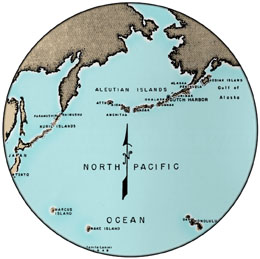
Alaska's location was considered strategic during World War II because of it being the closest U.S. land mass in proximity to Japan as well as a supply point for West Coast military forces enroute overseas. The map to the right is a World War II rendering of the Aleutian Chain and the islands' close proximity to Japan courtesy of the National Parks Service. The efforts that reinforced Alaska as a strategic location that was key to success of the U.S. and their allies during World War II include the building of several military bases and the construction of the 1420 mile wilderness highway known formally as the Alaska Highway but also referred to as "the Alcan."
Military bases that were built include bases on Attu, Adak, Umnak, Unalaska and Kodiak Islands as well as bases in Sitka, Anchorage and Fairbanks. The majority of these bases have become World War II National Historic Landmarks.
The Alaska Highway was developed to provide a third transportation route to the Alaskan front during the war as transportation by boat or plane had been the only options up to that point. The war-time cost of building the highway came to $138 million, just under $100,000 per mile. The road was considered a necessity by President Roosevelt and he approved it's development in February 1942. The Alaska highway was completed by October 1943. Also of note is the importance of the building of the Alaska Highway in the Civil Rights movement due to three engineering units made up of African-Americans worked alongside the units of white engineers to construct the road. According to one historian "the Alaska highway was not only the greatest engineering feat of the Second World War, it is a triumph over racism."
Examine Question: Is there a National Guard unit in your area? Describe it including it's mission, size and recent activities.
The Air National Guard unit in my area is located at the Joint Base Elmendorf-Richardson (JBER). The 176th Wing includes over 1400 National Guard troops and their mission involves combat search and rescue, tactical and strategic air lift, air control and rescue coordination. There is also an Army National Guard Unit located at JBER. Currently 126 Army National Guard troops from the 143rd Infantry Regiment are serving in Afghanistan and will be stationed there through November 2012.
The Alaska National Guard based at JBER has recently been involved in saving two victims of a plane crash on Knik Glacier on March 30th, 2012 as well as many other humanitarian and rescue endeavors cited by the State of Alaska Department of Military and Veteran Affairs. These include medical trips to 16 villages near Nome and aide during recent snowstorms in Valdez and the Bering Sea region. In 2011 The Alaska Air National Guard also deployed 125 troops to Afghanistan to air drop food, water and supplies to soldiers serving abroad.
Evaluation:
I found the history and significance of World War II in Alaska rich with information that I never knew before taking this course. The building of the Alaska Highway was of great interest to me as I've heard stories from my grandfather who traveled the road in the 1950s and 1960s and describes it as more of a trail than the highway it was named as. The sources were helpful, but I did find it difficult to find specific information on the individual National Guard units and their numbers so extra links to sites on this subject may be helpful to include.
Claire brought up the fact that the landscape of Girdwood and Valdez have encouraged and brought about thriving ski slopes and heli-skiing ventures.
Margie mentioned that many Alaskan communities have festivals that celebrate birds, wildlife and Alaska's bounty. The Moose-dropping festival in Talkeetna comes to mind!
Heidi's discussion on various forms of Alaskan recreation was concise, yet thorough. I agree that basketball is a big part of Alaskan recreational culture and that it takes a whole to of gear and the right clothing for most outdoor activities!

Another wonderful blog. Very reader friendly. I agree that this Module was very interesting. I love learning about all the facets of WWII.
ReplyDelete